
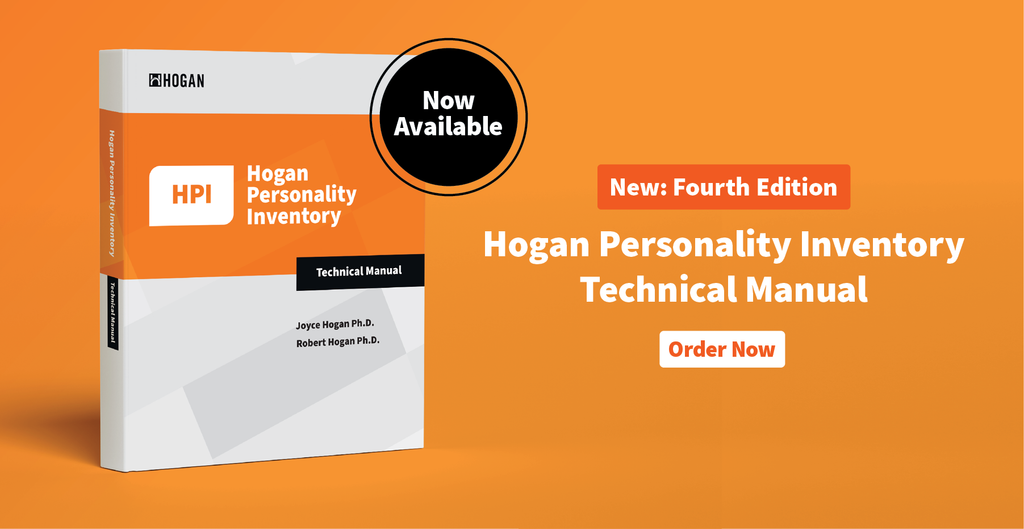
Hogan Assessments is pleased to announce the publication of the Hogan Personality Inventory Technical Manual: Fourth Edition. This edition is based on data from Hogan’s latest global normative dataset of more than 150,000 respondents.
The fourth edition also adds a dedicated chapter on equivalence and fairness across demographic groups. Together, these updates provide the strongest and most current technical foundation the Hogan Personality Inventory (HPI) has had to date.
What’s New in the HPI Technical Manual
A great deal has changed in the world of work since the previous edition of the HPI technical manual was published. Organizations are increasingly placing scrutiny on how assessments inform consequential decisions about people, such as hiring and development. Expectations around assessment transparency, fairness, and validation have therefore evolved substantially.
According to Jerod White, PhD, data science research consultant at Hogan, the science of personality assessment has evolved as well. “We now have access to much larger, more representative datasets and more sophisticated psychometric methods, allowing us to examine the HPI in ways that were not reflected in the previous manual,” he said.
Findings in the new edition affirm that the fundamentals of the HPI have not changed; rather, the evidence available to evaluate and support those fundamentals has advanced.
Assessment Equivalence and Fairness
One of the most significant questions for practitioners and organizations today is whether personality assessment is fair. Recent changes in employment law and organizational scrutiny around fairness have made it important to provide direct evidence regarding equivalence and assessment fairness across demographic groups.
This edition of the HPI technical manual directly addresses that question through a new chapter dedicated to detailed group comparisons and modern equivalence analyses.
“The new chapter gives practitioners strong evidence that HPI scores can be interpreted consistently across employees of different racial or ethnic backgrounds, ages, genders, and sexual orientations,” White said. "The results show generally small group differences and negligible differential test functioning, providing contemporary evidence to support fair and appropriate interpretation of HPI scores while reinforcing the importance of ongoing validation and responsible implementation.”
Expanded Data
Advances in psychometric methods, access to much larger archival databases, and decades of new validity evidence gave Hogan the opportunity to update and strengthen the technical foundation of the HPI using modern standards.
“The new manual affirms the HPI as a gold-standard assessment by demonstrating that its long-standing scientific foundation continues to hold up against modern standards,” said White. He emphasized that the manual brings together evidence from large, representative datasets with updated psychometric analyses. It also provides extensive evidence linking HPI scores to reputation, workplace performance, and leadership behavior across a wide range of jobs.
Additional Updates
The manual is now more streamlined and focused, consolidating key technical resources into a single reference document. Alise Dabdoub, PhD, director of product innovation at Hogan, observed, “The new edition makes it easier to answer customer questions, support responsible use of the HPI, and provide the technical evidence organizations need for assessment decisions and RFPs.” It continues to be useful for due diligence, legal review, and procurement processes.
Furthermore, the interpretation section of the manual has been updated. It now aligns with the current Hogan Guide and newer research on the strengths and challenges associated with high and low scores, providing clearer guidance on score interpretation for practitioners.
Dabdoub said that the updated manual makes the science behind the HPI easier to access and apply. “Practitioners now have up-to-date information that reflects the current assessment, along with clearer information about interpretation, validity, and fairness,” she said.
The HPI remains a highly reliable and valid predictor of workplace performance across a wide range of jobs and leadership roles. It continues to stand apart because it is grounded in socioanalytic theory and focuses on reputation and workplace effectiveness. "Together, the combination of theoretical grounding, extensive empirical validation, modern psychometric rigor, and evidence of fairness reinforces the HPI’s position as a well-supported assessment for workplace use,” White said.